Plugins, Modules, Add-ons, Contraptions: No game is an island
First, a quick note on the project title. After working through a proposal draft yesterday, I've got one I like (nothing like an external deadline to give me sudden clarity). And so, I present the production journal for:
The Tiny Toy Theatre Imagination Kit
It's tiny, as all of this expansive papercraft art is going to get all skrunched into dithered Decker screens. And considering the likely boundedness of my prototype, I think that the average user's imagination will be doing some heavy lifting.
...
Last night and this morning have mostly been devoted to background reading and fiddling with Decker, with support from this excellent, excellent guide of all kinds of Decker tricks by ahmwma - Phinxel's Phield Notes. ahmwma's guide enacts a trend that I find both charming and immensely helpful across many Decker guides -- the guide itself is built into a Decker deck, meaning that every strategy and illustration can be directly inspected to see how all the bits are working together. It saves space for curiosity and play, and it conceptually makes good on Decker as a tool of visibility communal support. It's also just fun to read, which is not an easy task for such a detailed guide. Here's a screenshot of an early page in Phinxel's Phield Notes:
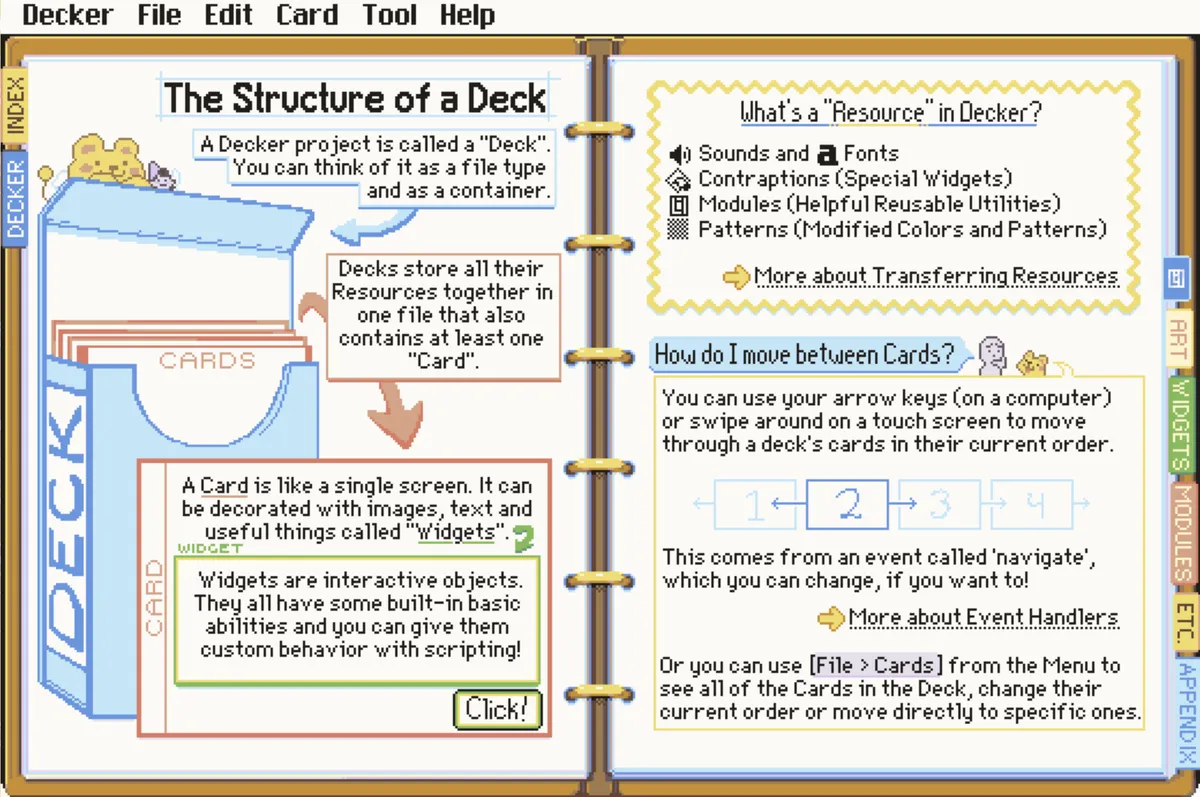
ahmwma's guide also nudged me to two more Decker modules that I plan to add into my own project, Dialogizer and (the aptly-named) Puppeteer.
Not much else to say at the moment, aside from the fact that I once again find myself leaning heavily on the generous and freely given labor of intermediary users as I'm learning a new system. As I mentioned before, learning Godot for my Bartholomew Fair project would have been an even more daunting task without the assistance of the Popochiu plugin.
Writing these posts, too, couldn't happen as easily as they do without Bear Blog, which I'm loving more and more each time I fiddle with a post.
Again and again, I return to this excerpt from Ross Gay's acknowledgements in Be Holding, one of the most generous and expansive books of poetry I've ever read:
Nothing I write I write by myself. Everything I write, by which I mean everything, I write with and for and from others, which is a way of saying, always, debt. Which is a way of saying, always, gratitude. A way of saying, always, I am beholden. The older I get the more beautiful this becomes to me—how much, how completely, I am made by others. How I can often trace an overt lineage in my work, but how more often than not, I know this to be true (how could it not?), the lineage disappears into me.
Or, in another line a bit further down that I can't help but quote and remember again and again:
A poem's practice, the practice of poetry, must always defy the logics of property. By which I mean practicing the truth of gift and gratitude.
Besides keeping an external record that eases the process of my own memory and recall down the road, I hope this production journal also maps and maintains the many threads of gratitude that patch my work together.