Copy/paste scripting woes and early Twine mapping
The past couple weeks have been slow going on this project, but I've been picking away at building more familiarity with Decker, especially in terms of learning how I'll allow players to choose particular characters/sets/materials and save those choices for their final product. It's not a very complex process, but I was overthinking it while simultaneously familiarizing myself with Lil, the Decker scripting language.
When players choose a particular character for their toy theatre stage (indicated through clicking either the character's image or perhaps a button next to them), I'd like that character image to be copied and pasted into a canvas on separate card elsewhere in the Deck -- the "finale" card, more or less. Once the player makes it through the whole selection process, they'll see the various fruits of their decision-making labor laid out for them, at which point they can drag the various characters around to their heart's content.
In some ways, the functionality is not unlike John Earnest's "Valentine-er" deck, which gave me all kinds of ideas for similar implementation. And, of course, the pleasure of Decker is that it's easy to download the Valentine-er deck onto my own computer and poke around in its scripts and guts in order to see how it all works. The issue, honestly, was that my goals are even simpler than Earnest's strategies here (I don't need the dynamic tables, for example), and so working to replicate his scripts left me bonking my head against a wall while failing to twist them into my own implementations.
In my early mock-ups, it was easy enough to build this functionality into a single card, but I just couldn't quite wrap my mind around getting the copy/paste function to carry across cards. I knew that I was incorrectly handling the syntax of naming and calling these cards and widgets. Eventually, ahmwma's Decker guide once again came to my aid. The readability and replicability of their deck is truly a gift.
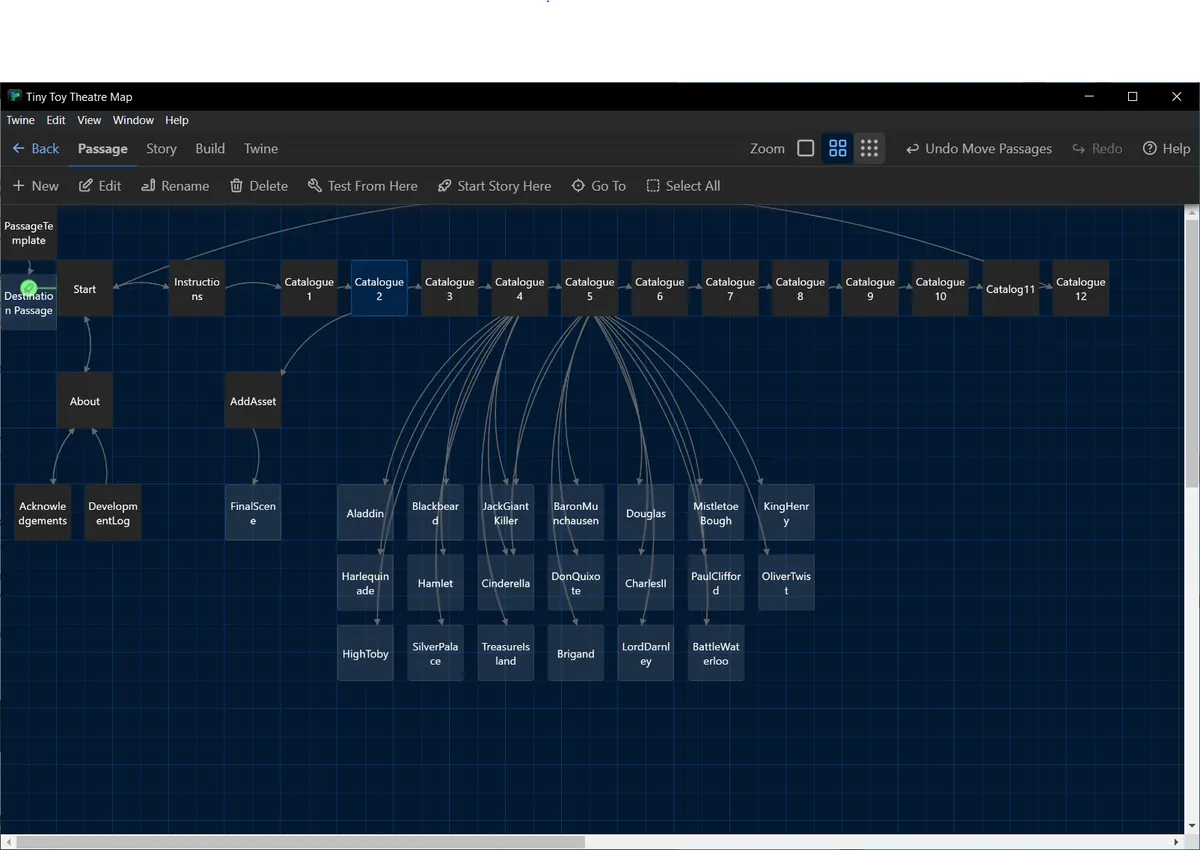
What I also learned in this process is that keeping Decker's card-based system clear in my mind wasn't working so well. The more I tried to imagine the nested web of links that will eventually underpin this project, the more the shape of this thing slipped out of my mind. And so, I've returned to my first love, Twine, in order to map out some of these relationships. Here's a quick image of my mapping in progress, and my next process post will talk more about my Twine methods in detail.